Air conditioning problems often become most noticeable at the least convenient time. The cabin may stay comfortable while cruising on the freeway, then start warming up after a few minutes of sitting at a long light or crawling through stop-and-go traffic.
That pattern gives technicians an important clue because the A/C system operates under very different conditions when the vehicle is moving compared with when it is stationary. Airflow across the condenser, engine speed, cooling fan operation, refrigerant pressures, and underhood temperature can all change once road speed drops.
Condenser Airflow Changes When the Car Stops Moving
The A/C condenser sits near the front of the vehicle and releases heat from the refrigerant before it continues through the rest of the system. While the vehicle is moving, outside air naturally passes through the grille and across the condenser.
At a stop, that natural airflow disappears. The cooling fans have to provide enough airflow on their own. If airflow becomes insufficient, refrigerant pressure and temperature can rise, making the system less effective at removing heat from the cabin.
A Weak or Failed Cooling Fan Is a Common Place to Look
Many vehicles use electric fans behind the radiator and condenser. Depending on the design, one or more fans may run when the A/C is switched on, when refrigerant pressure reaches a certain level, or when engine temperature requires additional cooling.
A failed fan motor, relay, control module, resistor, fuse, wiring problem, or damaged connector can prevent the fan from reaching the required speed. The A/C may still cool reasonably well at 40 or 60 mph because road airflow is doing the fan's job, then lose effectiveness almost immediately in traffic.
Some vehicles use multiple fan speeds. A fan that works at high speed but not low speed can create a less obvious problem: cooling may be acceptable in certain situations but poor during ordinary idling.
A Dirty or Restricted Condenser Can Reduce Heat Transfer
The condenser needs both airflow and a clear surface to release heat effectively. Bugs, leaves, dirt, road debris, and bent fins can block airflow through the condenser.
A restriction may have little noticeable effect while the vehicle is moving quickly because the remaining open area still receives substantial airflow. At idle, when airflow is already lower, the restriction becomes much more important.
Technicians can inspect the condenser for debris, physical damage, and areas where the fins have become heavily bent. Cleaning needs to be done carefully because thin aluminum fins can be damaged easily.
Low Refrigerant Can Show Up More Clearly at Idle
A refrigerant leak can gradually reduce the amount of refrigerant circulating through the system. The A/C may still produce some cold air, especially under favorable operating conditions, but it may struggle more during idle and low-speed driving.
Don't simply top off low refrigerant repeatedly. An automotive A/C system is sealed, so a low charge means refrigerant has escaped somewhere. Hoses, O-ring connections, compressor seals, condensers, evaporators, and service ports are among the areas that may need to be checked.
Too much refrigerant can also cause poor cooling. The system should be charged according to the specified amount rather than by feel or vent temperature alone.
Compressor Performance Can Change With Engine Speed
The A/C compressor circulates refrigerant through the system. On belt-driven compressor designs, compressor speed changes with engine RPM.
A worn compressor may perform adequately when engine speed rises but struggle to create the expected pressure difference at idle. Internal wear, control valve problems on variable-displacement compressors, clutch concerns on applicable designs, or belt-drive problems can all influence performance.
That does not mean an A/C system that cools better at highway speed automatically needs a compressor. Check pressure readings and system operation first, because poor condenser airflow can cause a very similar complaint.
High Refrigerant Pressure Can Cause the System to Cycle Off
When condenser airflow is inadequate, high-side refrigerant pressure can rise considerably while the vehicle sits still. The A/C control system monitors pressure and may reduce compressor output or shut the compressor off to protect components.
The driver may notice the vents warming at a stop and then cooling again soon after the vehicle begins moving. If this pattern repeats consistently, checking condenser airflow and cooling fan operation is an important part of the inspection.
Possible clues include:
- A/C gets warmer at long traffic lights
- Cooling improves quickly once road speed increases
- Radiator or condenser fans do not run with the A/C on
- Fan operation sounds different than it used to
- A/C cycles on and off frequently at idle
- Engine temperature also rises in traffic
If engine temperature is climbing along with A/C temperature, the cooling fan system deserves prompt attention.
Engine Cooling Problems Can Affect A/C Operation Too
The engine cooling system and air conditioning system share the same general airflow path through the front of the vehicle. If the engine begins running hotter than expected, the vehicle may reduce or disable A/C operation to lower heat load and protect the engine.
A weak cooling fan, restricted radiator, low coolant level, or another cooling system problem can therefore appear to the driver as an A/C complaint. Watching engine temperature while the A/C performance changes can provide another useful clue.
If an overheating warning appears, the engine cooling concern takes priority. Continuing to operate an overheating engine can lead to far more serious damage than a loss of cabin cooling.
Cabin Airflow Should Be Checked Separately
Sometimes the air from the vents feels warmer because airflow has weakened rather than because the refrigerant system has stopped cooling.
A heavily restricted cabin air filter, weak blower motor, damaged blower resistor or controller, or air-distribution door problem can reduce the amount of conditioned air reaching the cabin. These concerns usually behave differently from a condenser airflow problem, but they should still be considered if vent airflow itself changes with the complaint.
How Technicians Test an A/C Problem That Happens in Traffic
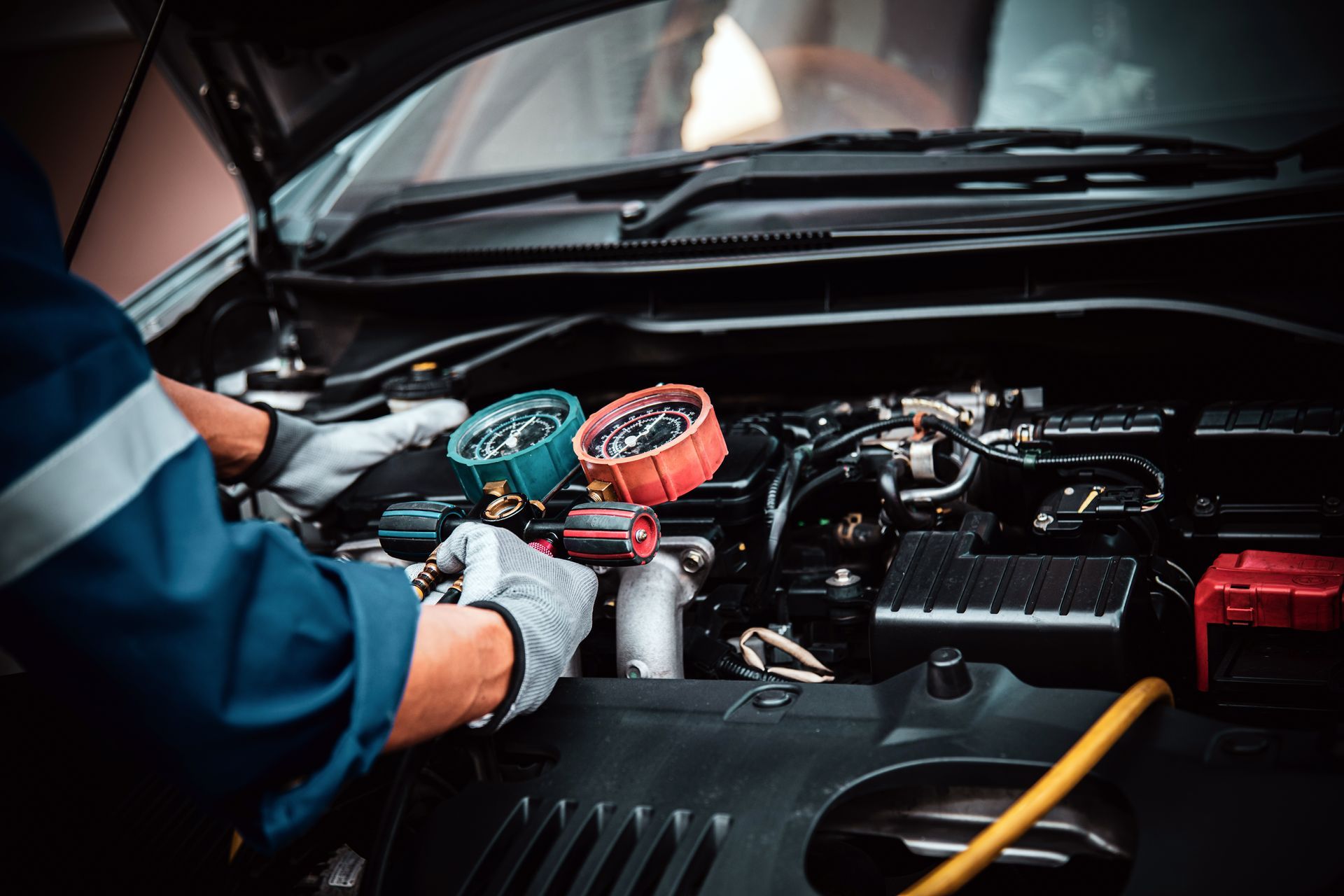
It helps to reproduce the problem under the conditions where it normally occurs. Technicians may monitor vent temperature, refrigerant pressures, compressor operation, fan speed, and engine temperature while the vehicle idles with the A/C running.
If cooling improves when additional airflow is directed across the condenser, that points testing toward the fan or airflow side of the system. If pressures remain abnormal even with good airflow, attention can shift toward refrigerant charge, compressor operation, restrictions, or other A/C components.
Get A/C Service in Santa Clarita, CA, With Power Automotive
Power Automotive in Santa Clarita, CA, can inspect cooling fan operation, refrigerant pressures, condenser condition, compressor performance, and other causes of A/C that becomes warmer in traffic.
If your air conditioning feels cold on the highway but struggles at stoplights or during slow driving,
contact us to schedule an A/C inspection and service.